Chapter 7
Committing & drift
Commit is the only thing in Buckley that writes. Everything before it is a draft you can walk away from.
Review before you write
Commit to bucket opens a preview of exactly what will happen to each container — grants in green, revokes in red. If nothing differs, it says No net changes and there is nothing to confirm.
Read it. It is the last honest description of what is about to happen, and it is the only place a surprise revoke shows up before it is real.
The commit itself
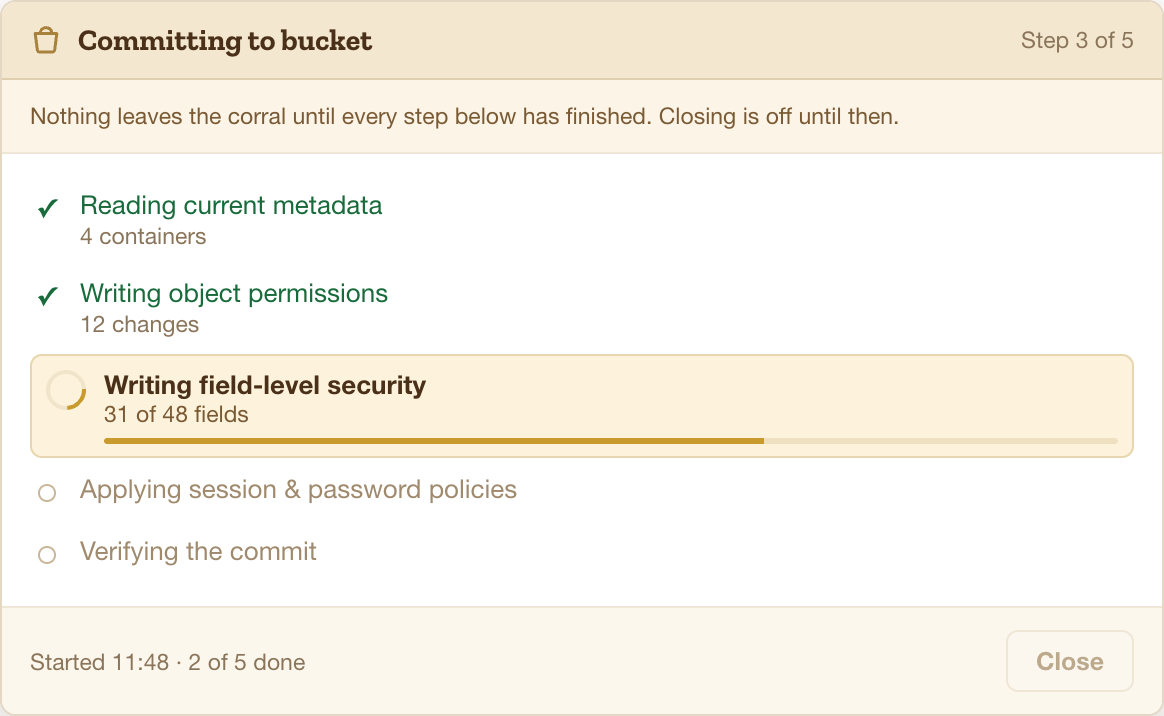
Buckley works through the commit in steps: reading current metadata, writing object permissions, writing field-level security, applying settings, verifying. The running step shows its own progress; finished steps carry a check.
Close stays disabled until it finishes. A half-written commit is worse than no commit, so Buckley does not offer you a way to walk out mid-write.
Undo
Undo restores every container to exactly what it held before the commit. Buckley snapshots the previous state as its first step, which is what makes this possible.
Undo covers the last commit only. It is a safety net for “that was wrong”, not a history you can walk back through.
Drift
Drift answers one question: how many containers in this bucket already match the target?
A bucket at 4 of 4 is fully aligned — committing would write nothing. A bucket at 1 of 4 means three containers differ from what you have said you want.
Drift is not an error. A bucket can sit at 2 of 4 quite deliberately, because two containers are locked and meant to stay different. What drift gives you is the number, so the difference is a decision rather than an accident.
Drift recalculates as you edit, before you commit. Watching it climb to n of n is the fastest confirmation that your target says what you meant.